
The American Civil War
North v South
On this Page:


12 April 1861 to 26 May 1865


1.0 Introduction and Overview
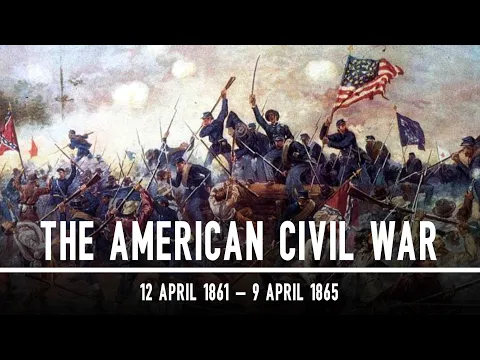
The American Civil War (1861–1865) was the defining crisis of the United States. Fought between the northern states (the Union) and eleven southern states that seceded to form the Confederate States of America, the four-year conflict claimed an estimated 620,000 to 750,000 soldiers' lives, preserved the United States as a single nation, and brought an end to the institution of slavery.
Causes & The Breakdown of Compromise
The conflict arose from deep-seated sectional divisions between the agrarian South and the increasingly industrialised North. At the heart of these tensions was the institution of slavery, which was fundamental to the South’s plantation economy and social structure.
For decades, political leaders attempted to balance power between free and slave states through legislative agreements, including the Missouri Compromise of 1820 and the Compromise of 1850. However, the expansion of U.S. territory intensified debate over whether slavery would be permitted in new western regions. Ideological friction escalated over:
Disputes regarding states’ rights versus federal authority
The legal enforcement of the Fugitive Slave Act
Violent clashes in "Bleeding Kansas"
The Supreme Court's 1857 Dred Scott decision
The breaking point arrived with the election of Abraham Lincoln as President in November 1860. Running on a Republican platform that opposed the extension of slavery into new territories, Lincoln won without carrying a single Southern state. Viewing his victory as an existential threat, South Carolina seceded from the Union in December 1860, followed shortly by ten other Southern states.
The Arc of the War
The war began on April 12, 1861, when Confederate forces fired on Fort Sumter in Charleston Harbour, South Carolina.
Outbreak of War & Early Stalemate: 1861–1862
Confederate forces under General Robert E. Lee scored major tactical victories in the Eastern Theatre, notably at Bull Run and the Seven Days Battles. However, the bloody battle at Antietam (September 1862) halted Lee's northern advance, giving President Lincoln the political leverage to issue the Emancipation Proclamation, which declared enslaved people in Confederate territories free as of January 1, 1863.
The Turning Points: July 1863
The war shifted decisively over three crucial days. At Gettysburg, Union forces repelled Lee’s second invasion of the North. Simultaneously, General Ulysses S. Grant secured the surrender of Vicksburg, granting the Union complete control of the Mississippi River and splitting the Confederacy in two.
Total War & Confederate Collapse: 1864–1865
Appointed general-in-chief, Grant engaged Lee in a relentless campaign of attrition in Virginia, while General William Tecumseh Sherman waged a destructive "March to the Sea" across Georgia. Starved of resources and manpower, Lee surrendered to Grant at Appomattox Court House on April 9, 1865.
Outcome & Legacy
The war fundamentally transformed the nation. Days after Lee’s surrender, President Lincoln was assassinated by John Wilkes Booth, leaving the country to navigate its recovery without his leadership.
The Reconstruction era (1865–1877) followed, marked by efforts to rebuild the South and integrate millions of newly freed Black Americans into the republic. Through the passage of the 13th, 14th, and 15th Amendments, the U.S. Constitution formally abolished slavery, guaranteed equal protection under the law, and granted voting rights regardless of race—laying the legal groundwork for the ongoing struggle for civil rights in America.
Videos



Updated: 27 October 2026
Connect
Stay updated with my online activities.
CONTACT
Email Me via the Link Below:
© 2025. All rights reserved.
© 2025-2026 Kevin Matthews - https://particularkev.com