


THE FORMATION OF GERMANY AND THE GERMAN EMPIRE
Part 3: The Man with the Iron Strategy
On This Page:


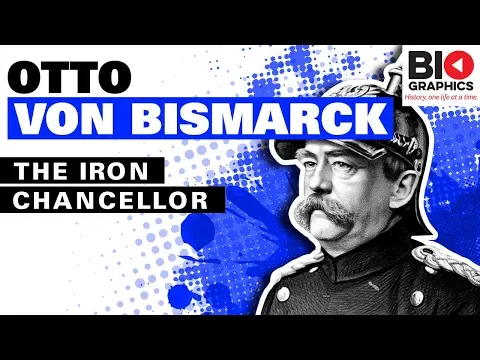
ABOVE: Otto von Bismarck
1. The Crisis of 1862: A Monarchy on the Brink
In September 1862, the Kingdom of Prussia was locked in a bitter constitutional paralysis that threatened to dismantle its government.
The issue on paper was military reform. King Wilhelm I, who had assumed the Prussian throne in 1861, was a career soldier determined to expand, modernise, and professionalise the Prussian army. He wanted to increase the annual draft intake, extend compulsory active service from two years to three, and reduce the role of the Landwehr—the popular citizen militia that had fought against Napoleon but was viewed by the professional officer corps as politically unreliable.
The Prussian Parliament (Landtag), however, was dominated by the Progressive Party—a powerful coalition of wealthy liberal merchants, lawyers, and industrialists. Having witnessed the failed revolutions of 1848, the liberals viewed the control of the state budget as their ultimate parliamentary right. They saw the King’s army reforms as a double threat: an exorbitant financial burden and an attempt by the conservative monarchy to build a standing army that could be turned against its own citizens.
The parliament repeatedly refused to pass the budget needed to fund the King’s military expansion. By the autumn of 1862, the government was operating without a legal budget. King Wilhelm I was despondent, exhausted, and convinced his royal authority was ruined. With a drafted act of abdication sitting on his desk in Potsdam, he turned in desperation to his Minister of War, Albrecht von Roon.
Roon’s advice was brief and decisive. He telegraphed an enigmatic message to a diplomat stationed in Paris: "Delay is dangerous. Periculum in mora. Come."
The recipient of that telegram was a 47-year-old Prussian aristocrat named Otto von Bismarck. On September 23, 1862, King Wilhelm appointed Bismarck as Minister President and Foreign Minister of Prussia. It was an appointment that would permanently alter the course of European history.
2. The Junker from Pomerania: Who Was Bismarck?
To understand how Bismarck approached the central question of German unity, one must understand his origins and his worldview.
Born on April 1, 1815—just weeks before the Battle of Waterloo—in Schönhausen, west of Berlin, Bismarck belonged to the traditional Prussian landed nobility, known as the Junkers (pronounced "Yoon-kers").
In his youth, Bismarck was far from a model civil servant. At the University of Göttingen, he was notorious for duelling, drinking, and reckless antics, earning a reputation as a wild, undisciplined country squire. Yet beneath his imposing six-foot-plus physical stature lay an exceptionally sharp intellect, a mastery of European languages, and an uncanny ability to read human psychology.
Bismarck entered politics during the Revolutions of 1848 as a fiery, ultra-conservative defender of the monarchy. When liberals demanded constitutional rights, Bismarck argued that the King's authority came from God, not the people. He fiercely opposed the Frankfurt Parliament's offer of a national crown to King Friedrich Wilhelm IV in 1849, arguing that Prussia must never submerge its distinct identity or royal heritage into a chaotic democratic union.
However, Bismarck's political perspective matured significantly during his decade as Prussia’s envoy to the Federal Diet in Frankfurt (1851–1859) and later as ambassador to St. Petersburg and Paris.
In Frankfurt, sitting across the table from Austrian diplomats, Bismarck saw firsthand how Austria used the German Confederation to keep Prussia in a subordinate position. He realised that if Prussia was ever to secure its position as a great power, it could not rely on traditional conservative solidarity with Austria. It would have to break the existing system.
Key Term: Junkers
The conservative, land-owning aristocracy of Prussia. Historically, Junkers controlled the agricultural estates of Pomerania, Silesia, and East Prussia, and formed the officer class of the Prussian military and the top tiers of the state civil service.
3. The Philosophy of Realpolitik
Bismarck’s statecraft introduced a ruthless clarity to European diplomacy that contemporaries labelled Realpolitik.
Coined by the political writer Ludwig von Rochau in 1853, Realpolitik described a practical, calculating approach to governing. It rejected abstract philosophical ideals, moral crusades, and ideological consistency in favor of a cold assessment of power, national self-interest, and tangible results.
For Bismarck, Realpolitik meant that allies and enemies were never permanent; only Prussia's interests were. If advancing Prussian power required partnering with conservative Russia, he would do so. If it required utilising the economic energy of liberal nationalists—the very liberals he despised in domestic politics—he would harness their momentum without hesitating.
Realpolitik vs. Idealism
To grasp how revolutionary this was, contrast Bismarck’s philosophy with the two dominant political visions of his era:
Bismarck was neither a German nationalist in the modern romantic sense nor a blind reactionary. He was a Prussian monarchist who recognised that the status quo was unsustainable. If German unification was coming, it must not be brought about from below by a democratic movement that would sweep away the crown; it must be executed from above by the Prussian state.


"Prussia's position in Germany will not be determined by its liberalism but by its power... Prussia must concentrate its strength and hold it for the favourable moment, which has already been missed several times. Prussia's borders according to the Vienna treaties are not favourable to a healthy state life. Not through speeches and majority decisions will the great questions of the day be decided—that was the great mistake of 1848 and 1849—but by iron and blood."
— Otto von Bismarck, September 30, 1862
4. "Blood and Iron": The Speech That Defined an Era
A week after taking office in September 1862, Bismarck walked into a meeting of the Prussian Parliament's Budget Committee to address the ongoing constitutional deadlock.
The liberal deputies expected a compromise or a formal apology for the government's illegal spending. Instead, Bismarck delivered a brief, extemporaneous speech designed to shatter their illusions about how history was made.
He warned the committee that Prussia's geographic boundaries were poorly suited for its security, and that the state must build up its strength for the opportune moment:
The reaction across Central Europe was immediate shock. Liberal newspapers condemned Bismarck as a dangerous dictator intent on establishing a military tyranny. The King himself panicked, fearing that Bismarck’s defiant language would spark a revolution that would bring down the House of Hohenzollern.
Bismarck remained unmoved. When Parliament refused to authorise the state budget, he simply invoked a legal loophole of his own creation known as the Gap Theory (Lückentheorie).
He argued that since the constitution did not specify what should happen if Parliament and the King failed to agree on a budget, a "gap" existed in the law. In the event of such a deadlock, the state administration had a duty to keep the government running, collect taxes, and pay the army according to the previous budget. For four straight years (1862–1866), Bismarck governed Prussia without a legally approved budget, ignoring parliamentary protests while von Roon and General Helmuth von Moltke built the most formidable fighting force in Europe.
5. The First Chess Move: The Danish War (1864)
Bismarck understood that to accomplish his long-term goal—driving Austria out of the German Confederation and establishing Prussian supremacy—he needed a pretext to test his newly modernised army and create a rift between Berlin and Vienna.
That pretext arrived in the northern borderlands of Schleswig and Holstein.
These two northern duchies had been ruled for centuries by the King of Denmark in a personal union, though Holstein remained a member state of the German Confederation. In 1863, the new Danish King, Christian IX, enacted a new constitution that attempted to formally annex Schleswig directly into the Kingdom of Denmark, violating international treaties.
Nationalist sentiment erupted across the German states. Liberals and princes alike demanded that the German Confederation intervene to protect the German population of the duchies.
While the Confederation’s Diet favoured supporting a third-party German prince to rule the duchies, Bismarck saw a completely different opportunity. Using Realpolitik, he took control of the crisis through a series of calculated manoeuvres:
Diplomatic Isolation: Bismarck ensured that foreign powers would not intervene. He secured the goodwill of Russia by assisting the Tsar during a Polish uprising in 1863, and he accurately calculated that Britain would not enter a continental war over a Scandinavian border dispute.
Entrapping Austria: Rather than acting through the German Confederation, Bismarck persuaded Austria to join Prussia in a joint military intervention as co-signatories of international treaties.
The Brief Campaign (1864): In February 1864, allied Prussian and Austrian forces crossed the Eider River into Denmark. The modernised Prussian military, utilising breech-loading needle guns and coordinated staff logistics, quickly defeated the Danish army.
In August 1865, under the Convention of Gastein, Prussia and Austria agreed to divide the spoils. Prussia took over the administration of Schleswig in the north, while Austria took over Holstein.
It was an intentionally flawed arrangement engineered by Bismarck. Holstein was completely surrounded by Prussian territory and separated from Austria by hundreds of miles. By placing Austrian officials inside an enclave surrounded by Prussian soldiers, Bismarck had created an ideal, permanent friction point—a diplomatic fuse that he could ignite whenever he was ready to force a final showdown with Vienna.
6. Looking Ahead: The Looming Brothers' War
By 1865, Otto von Bismarck had completely reshaped the landscape of Central European politics. In just three years, he had bypassed parliamentary opposition, funded a military machine, secured the neutrality of Europe's major empires, and manoeuvred Austria into a diplomatic trap in the windswept duchies of the north.
The stage was now set for the decisive conflict that German thinkers had contemplated for over a century: the final resolution of German Dualism.
In the next article, "Brothers at War: Settling the German Question," we will examine how Bismarck turned the tension in Holstein into a full-scale war in the summer of 1866, shattered Austrian dominance in a seven-week campaign, and established the North German Confederation—the direct precursor to the German Empire.

7. Videos


Updated: 31 OCTOBER 2026
Connect
Stay updated with my online activities.
CONTACT
NEWSLETTER:
Email Me via the Link Below:
© 2025. All rights reserved.